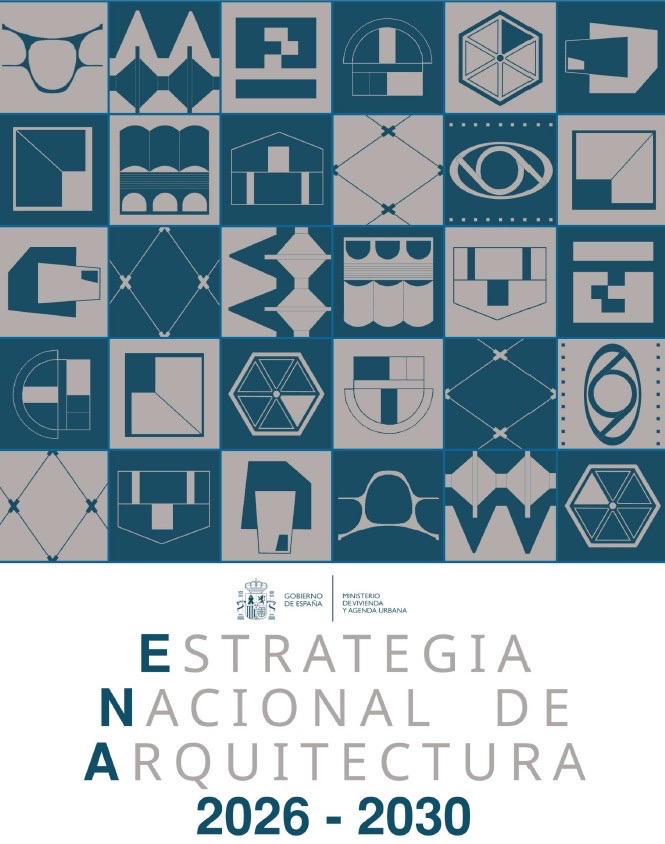
The Ministry of Housing and Urban Agenda has opened the public consultation and information period for the National Architecture Strategy (ENA) 2026–2030, a planning and governance instrument aimed at recognising architectural quality as a matter of general public interest and contributing to the sustainable transformation of our built environments. Its principles of quality and ecological transition are closely aligned with the values of the New European Bauhaus.
The participatory process will remain open on the Ministry’s website until 30 November and will provide an opportunity to gather contributions from citizens, public authorities, universities, professional associations and other stakeholders involved in architecture and urban planning across Spain.
Quality Architecture and Well-being
The ENA stems from the mandate established by Law 9/2022 on the Quality of Architecture, with the aim of placing architecture at the heart of major social, environmental and territorial challenges. Its cross-cutting approach highlights the role and importance of the spaces we inhabit in our health, well-being and quality of life, as well as their ability to foster social cohesion, protect the built heritage and contribute to the fight against climate change.
This document incorporates European principles for the architectural quality of the built environment, particularly those promoted by the European Commission through the New European Bauhaus (NEB), as well as the concept of Baukultur, developed following the 2018 Davos Declaration. Both perspectives share a comprehensive vision of architecture that goes beyond technical and functional aspects to encompass its cultural, social, environmental and aesthetic dimensions.
In this respect, the ENA incorporates the values of the New European Bauhaus — sustainability, inclusion and beauty — alongside the Baukultur vision of promoting high-quality built environments that meet people’s needs, respect the identity and distinctive character of each place, and contribute to collective well-being.
Seven Challenges and Eight Strategic Priorities
The ENA is structured around seven challenges, eight strategic priorities and approximately 54 measures, including 12 key enabling measures designed to facilitate its implementation.
The challenges address fundamental issues for the future of architecture, such as access to housing, the climate emergency, health and well-being, the modernisation of the existing building stock, public procurement, architectural culture, and territorial and cultural diversity.
To address these challenges, the strategic priorities focus on promoting and recognising Spanish architecture through the following areas:
- access to housing;
- sustainability, energy efficiency and building renovation;
- innovation, digitalisation and industrialisation;
- quality in public procurement;
- the relationship between people, the built environment and health;
- the territorial dimension;
- and the protection and conservation of architectural heritage.
This approach establishes a direct link between the concept of architectural quality and the objectives shared by European policies such as the NEB and Baukultur initiatives mentioned above. These include the ecological transition, urban regeneration, social inclusion and the improvement of everyday spaces.
Open Participatory Process
The development of the ENA involves collaboration between different levels of government and key stakeholders across the sector, together with consultation mechanisms and opportunities for public participation. The opening of the public consultation and information period represents an opportunity to enrich the document and contribute to a shared strategy for the future of architecture in Spain.
This process is essential to advancing towards an architectural culture that recognises the value of the built environment and promotes more sustainable, inclusive, healthy and high-quality spaces that respond to people’s needs.
Further information is available through the following link on the MIVAU website.