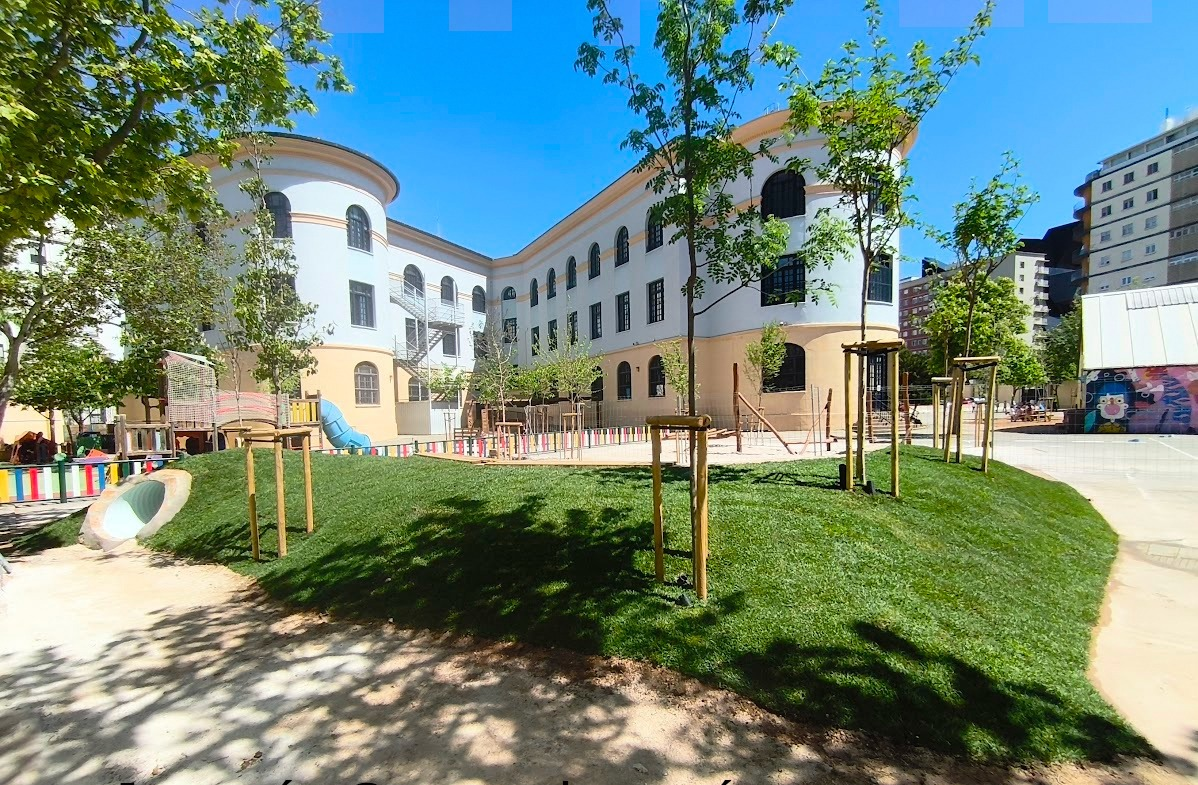
Cities are facing increasingly high temperatures that particularly affect the most vulnerable urban areas. In this context, transforming school playgrounds can become an opportunity to improve children’s well-being, reconnect them with nature, and move toward more resilient cities.
In Zaragoza, the project called “Adapta tu patio” (Adapt Your Playground), launched in 2024, proposes precisely this transformation: turning the playgrounds of public schools—including those focused on special education—into greener, more inclusive spaces that are better equipped to cope with the effects of climate change. To achieve this, the initiative combines bio-based solutions, participation from the educational community, environmental education, and design.
The regeneration of these environments begins with their unique characteristics: school playgrounds are particularly exposed to high temperatures and, in many cases, feature impermeable surfaces and little vegetation. In contrast to this traditional model, the proposal incorporates trees and other plant species, shaded areas, permeable paving, gardens, and new spaces dedicated to play, rest, and outdoor learning.
Thus, the goals are to reduce heat exposure, promote biodiversity, and improve rainwater management, while creating more pleasant spaces for the entire school community. In addition, natural elements can serve as educational resources, for example, allowing students to observe plant life cycles. Because of all these attributes, the initiative has been selected as a finalist in the New European Bauhaus Prizes 2026, in the category “Improving Circularity, Sustainability, and Innovation.”
Participatory Design and Inclusion of the Arts
Each school participates in a diagnostic and co-design process involving teaching staff, students, and their families. Through working groups and participatory workshops, the needs of each school are identified, and solutions are defined that best address those needs. This methodology allows each playground to have its own unique identity.
Furthermore, the initiative incorporates an artistic dimension, as each project includes the creation of a mural by a local artist, designed with student participation. In this way, inclusive cultural creation, thermal comfort, and a reconnection with nature are interwoven within the same ecosystem.
More and more centers are participating in the project launched by the Zaragoza City Council. The call for proposals allocates approximately 50,000 euros to each school for the interventions, in addition to resources for drafting project proposals, co-creation sessions, construction supervision, and the creation of the artistic mural. A Catalog of Climate Solutions and three project development guides are also provided to help other schools launch their own renaturalization initiatives.
The city council’s goal is to reach up to 72 schools in the city, so that an initiative that began with two pilot schools is now being positioned as a larger-scale urban transformation strategy. This same objective is being advanced through collaboration with other similar European networks and programs. One such example is NBS EduWORLD, a European initiative under the Horizon Europe program that links nature-based solutions with education.
Finally, as a closing note, the debate sparked by the project—regarding a new approach to urban planning that involves listening to those who use these spaces, fostering collaboration across different disciplines and government agencies, and using nature as a tool to address not only environmental but also social problems—is particularly interesting.